For decades, passionate growers and breeders shaped cannabis through experience, creativity, and careful observation. Today, that legacy is joining forces with modern crop science where genetic analysis builds on generations of expertise to bring new levels of precision and efficiency to cultivation.
At Phylos, we’re applying modern genetic and breeding science to unlock innovative commercial and production opportunities while preserving the diversity and character that make this plant extraordinary. From small farms to large-scale producers, we make it possible for growers of all kinds to deliver better, more reliable products that consumers love and trust. Here’s how genetic markers are helping us do just that.
From Observation to Innovation: Modernizing Cannabis Breeding
Traditional plant breeding depends on observing how plants grow and perform, known as phenotypic selection. Breeders identify desirable traits by evaluating plants over multiple generations and seasons. While effective, this process can take years and requires significant time and resources to stabilize new varieties or identify top-performing cultivars.
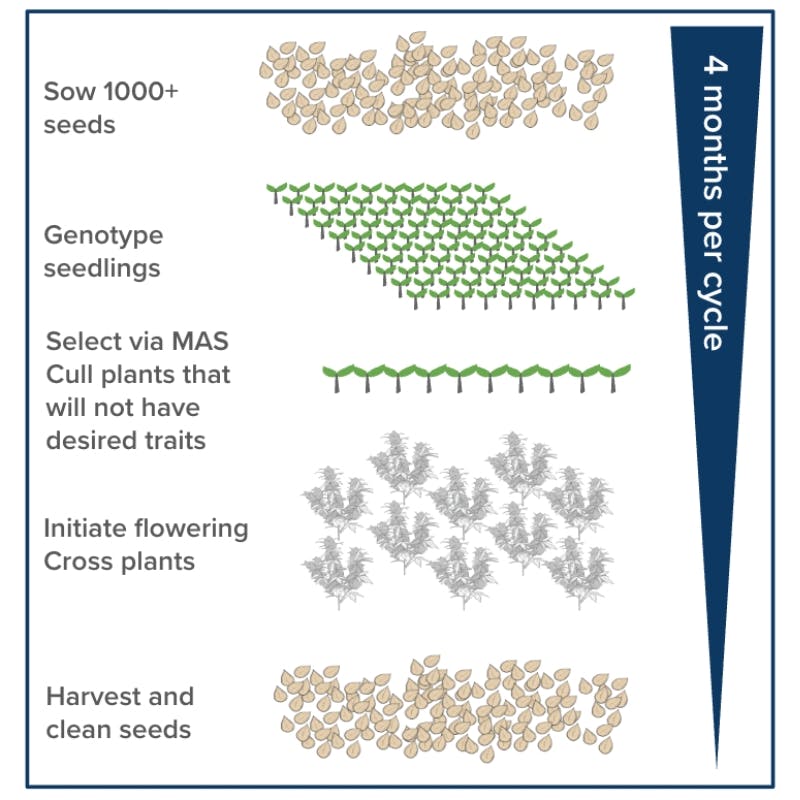
At Phylos, we accelerate the development of new cannabis varieties that deliver consistent success for growers and high-quality experiences for consumers, advancing the science of breeding in collaboration with, and inspired by, the innovators who came before us. By using genetic markers in a process called marker-assisted selection (MAS), we can identify and select plants with desirable traits much earlier in the breeding cycle. This increases our effective footprint, allowing Phylos to "observe" 20-50x more plants in the same cycle. We are also able to select and stack multiple traits. This would be nearly impossible without MAS.
Through MAS, DNA markers linked to important characteristics guide our selection process. This technology allows us to develop improved plant varieties faster, with greater precision, and with fewer resources than traditional methods.
The result? Faster development timelines, more consistent outcomes, and improved ROI for growers. Below is an example of one MAS cycle.
What Are Genetic Markers?
Think of genetic markers as molecular signposts in a plant’s DNA. They’re specific DNA sequences that are tightly linked to important traits like resistance to disease, flowering time, or cannabinoid production, to name a few.
Finding a genetic marker begins with understanding the connection between a plant’s DNA and the traits it expresses. At Phylos, we start by studying a diverse population of plants that show variation in traits of interest—such as cannabinoid or terpene profiles, yield, disease resistance, or stress tolerance.
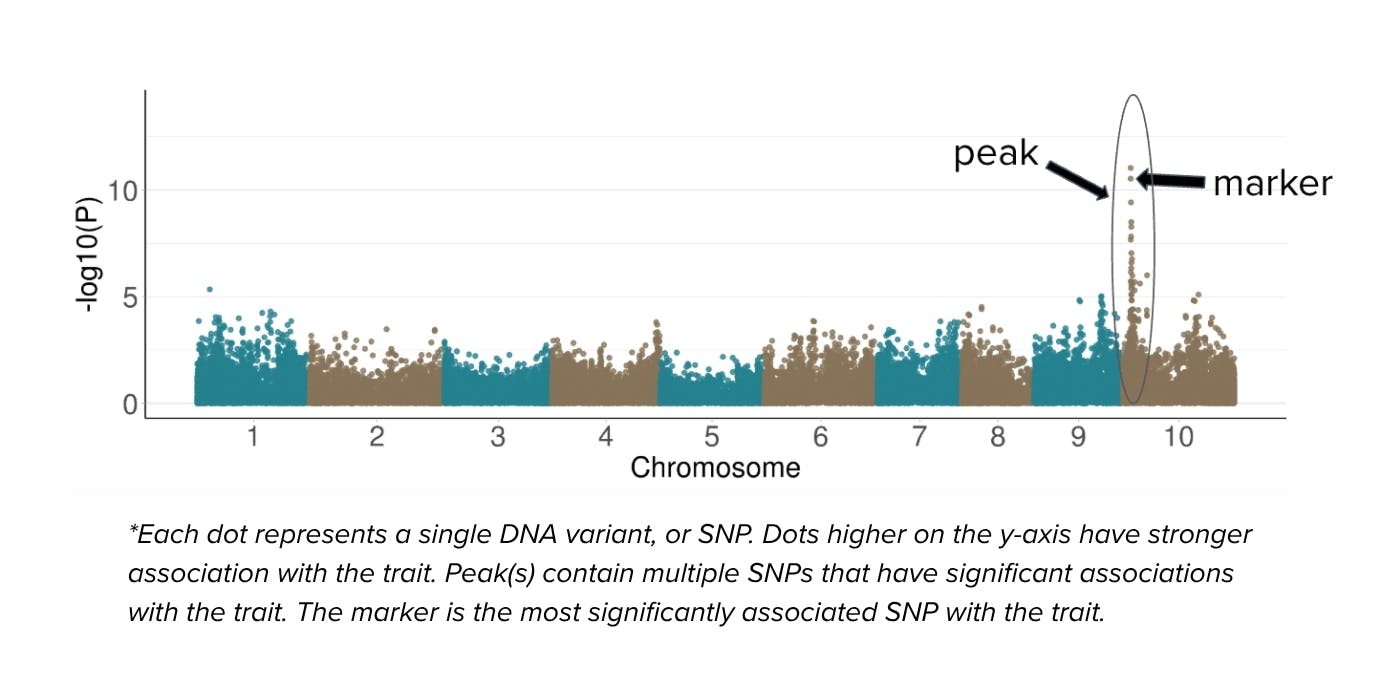
Using genotyping, we analyze the DNA of these plants to identify tens of thousands of genetic variants called single nucleotide polymorphisms (SNPs). We then use statistical and bioinformatic tools to look for correlations between specific SNPs and the observed traits. When a particular genetic variant consistently appears in plants that express a desired trait, it becomes a genetic marker.
Once validated through additional testing, these markers serve as reliable indicators for that trait. Instead of waiting for plants to fully mature to see how they perform, breeders can now screen seedlings at the DNA level to determine which ones carry the genetic potential for success.
This approach dramatically accelerates breeding—reducing time, cost, and uncertainty—while maintaining a data-driven connection between plant genetics and real-world performance.
From Discovery to Enablement
Let’s dive deeper into how Phylos identifies genetic markers:
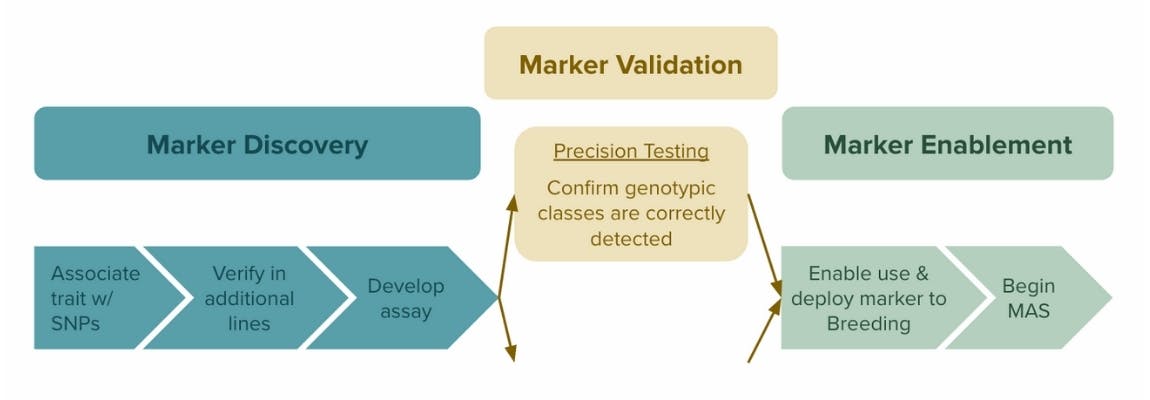
1. Marker Discovery
1.1. Associate traits with DNA markers (SNPs): Identify genetic variants linked to desirable traits like yield, resistance, or flowering time. This forms the foundation for understanding which parts of a plant’s genome drive performance and quality.
1.2. Verify in additional lines: Test more plants to confirm that the marker consistently appears with the trait, ensuring it’s not just a coincidence in the discovery populations. This step strengthens confidence that the marker truly represents the target trait.
1.3. Develop a reliable assay: Create a laboratory test (e.g., PCR or sequencing-based) to easily detect the marker in future breeding lines. Once developed, this assay becomes a practical, repeatable tool that breeders can use at scale.
2. Marker Validation
2.1. Precision testing: Confirm that the marker correctly distinguishes between genotypic classes (for example, resistant vs. susceptible plants). Precision ensures that breeders can make selections early, without wasting time on uncertain results.
2.2. Accuracy testing: Ensure that the marker reliably predicts the trait across multiple varieties and environments with known outcomes. This step validates the marker’s usefulness in real-world breeding conditions.
3. Marker Enablement
3.1. Enable and deploy marker to breeding: Integrate the validated marker into routine breeding workflows so it can guide plant selection. This marks the transition from research to application, where the marker begins to deliver measurable impact.
3.2. Begin marker-assisted selection (MAS): Use the marker data to select the best plants early, accelerating development time and improving reliability. Over time, MAS helps establish a data-driven pipeline that reduces uncertainty and boosts cultivar success.
Phylos is Unlocking the Potential of Cannabis
Our incredible breeding team has been hard at work, creating new F1 hybrid varieties and inbred parent lines. To date, Phylos has mapped genetic markers for the following traits:
- Stress Tolerance
- Plant Height (short)
- Terpene Production
- Powdery Mildew
- Autoflower
- Flower Initiation
- Rare Cannabinoid Production: THCV, CBDV, CBGV, CBC
- Flower Color
Real-World Impact: Predictable Harvests, Better Business
Genetic markers are more than just a lab tool, they’re a gateway to faster and more sustainable agriculture. Whether you're a cultivator looking for more stable outcomes or a partner interested in collaborative development, Phylos is here to support your success.
Interested in bringing Phylos genetics into your operation? Reach out to us at customersuccess@phylos.bio, we’d love to explore which varieties will suit your unique needs.